Bernie's AI Fix
June 8, 2026

The world rightly worries about artificial intelligence, its threat to jobs, and the absence of safety or controls. Half-measures to regulate AI have been trotted out here and there, Pope Leo XIV has weighed in, but Senator Bernie Sanders announced the most drastic and interesting solution of all. He proposed that America’s largest technology companies hand over half of their equity to a federal government sovereign fund so the companies can be controlled and their profits can be shared with all Americans. To pull this off, he suggested a “one-time 50% tax” on AI giants, payable by handing over 50% of their shares to a publicly owned wealth fund managed by the government. Critics immediately cried expropriation and injustice, but President Donald Trump agreed in principle to the scheme. This was surprising, but it shouldn’t have been because the backlash against tech grows among MAGA members, too. He said to Silicon Valley: “You make them [Americans] partners in this revolution. It would be a beautiful thing.”
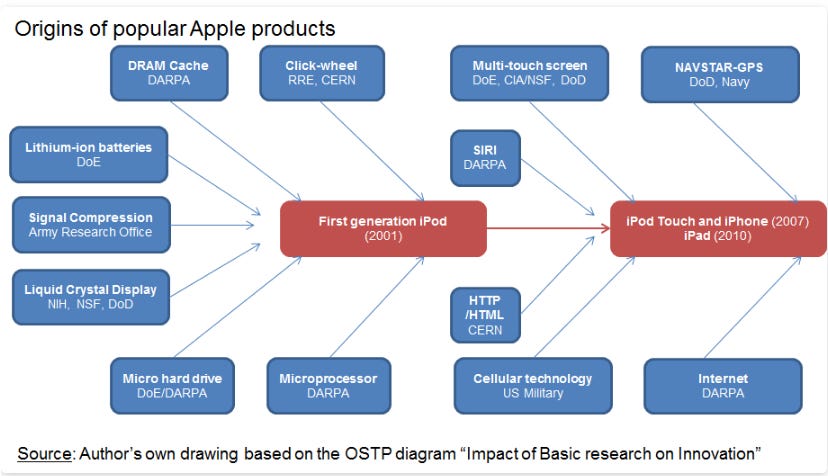
At first blush, Bernie’s idea is a combination of socialism and confiscation. But in fact, it’s only fair that Americans reap dividends from Silicon Valley because its early development was largely built on fundamental, publicly funded research that they provided as taxpayers. For instance, a $4.5-million National Science Foundation research grant awarded to Stanford University in the mid-1990s financed a digital library initiative by Larry Page and Sergey Brin that eventually became Google, now Alphabet.
Similar programs by DARPA, NASA, and the Department of Defense heavily subsidized the development of integrated circuits, GPS, deep learning, and the internet. DARPA (the Defense Advanced Research Projects Agency) was created in 1958 after Sputnik and is the research and development branch of the U.S. Department of Defense, tasked with creating breakthrough, high-risk technologies for national security. It is also at the cutting edge of science, invented an early version of the Internet, and has produced innovations that were available, without fees, to tech entrepreneurs. One expert estimated, for instance, that Steven Jobs repurposed billions of dollars’ worth of DARPA and other free research to create the iPhone without paying a dime in royalties.
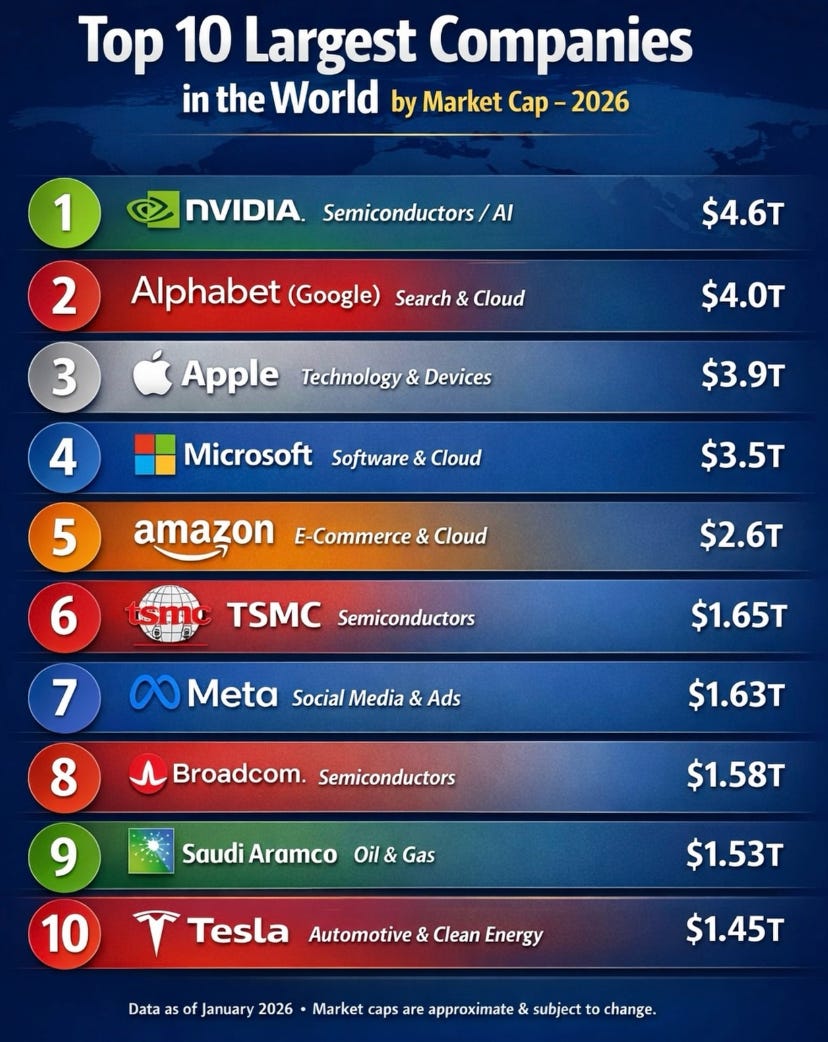
America has led the world in providing taxpayer-funded research funds to government agencies and universities and, as a result, underpinned America’s growth, reinvented the world, and allowed Silicon Valley companies to become staggeringly wealthy and powerful. In that context, it’s only fair that these profits should be shared with the American people who forked out these billions toward research. It’s also important to note that Sam Altman, OpenAI’s chief executive, also pitched the idea of the acquisition of stock in tech companies to Trump and policymakers in order to bridle and regulate AI research. The President has already started obtaining small stakes in Intel and some start-ups in rare earths and quantum computing on behalf of the government. But each deal was criticized by lobbyists, investors, and libertarians as un-American.
Buying half the shares of these companies would be impossible because of their stratospheric valuations. OpenAI, Anthropic, and SpaceX alone are going public and valued at trillions of dollars. Whenever Trump has “paid” for small stakes in small companies, it’s essentially a fee in return for government approval of transactions. However, Sanders’ idea of a one-time “tax” aims to get around legislative protection against expropriation without compensation to shareholders and will result in litigation. It would also be viewed as a form of “statism” that would be opposed by libertarians and raise fears of a Big Brother scenario.
However, sovereign wealth funds are a good idea. For instance, Norway and other resource-rich countries set up funds decades ago that re-invest proceeds from their country’s wealth (in oil and gas) for the benefit of the people who “own” the resources. Norway’s fund is $2 trillion in size and invests in enterprises at home and abroad, monitors their actions, and helps lower the cost of government services. Alaska has a similar fund that keeps state taxes low and distributes annual dividends to residents. More than 50 countries have sovereign wealth funds, including Australia, Middle Eastern countries, and China.
Trump’s regime intends to grow and regulate the sector, but also wants America to remain ahead of China in the global technology race. Politically, the polling shows that Americans are angry about the proliferation of data centers, looming power shortages, excessive wealth in the hands of a few people, and the adverse effects on children by unregulated social media companies. As a result, the public doesn’t trust the tech giants or the government. In addition, there are concerns about the issues that Pope Leo XIV raised, that machines will destroy human values and eventually humanity itself.
Sanders will push his audacious solution hard, and Trump must act quickly to create a public partnership with Silicon Valley and to bridle tech giants before they move offshore to duck regulation. Some are doing so, including Trump backer and tech honcho Peter Thiel (a partner of Elon Musk’s), who is relocating to Argentina, where its right-wing government has pledged to create unique corporate structures for technology that will make companies and owners immune from regulations, taxes, safety legislation, and ownership restrictions.
For this and other reasons, Bernie’s proposal is urgent. He announced his wealth fund scheme in a New York Times op-ed recently and correctly noted that “even President Trump, in an executive order, has proposed establishing an American sovereign wealth fund.” However, the suggestion of creating a fund was quickly attacked by The Wall Street Journal, which pointed out that such funds usually enrich the rulers and their friends more than citizens. “We blasted the President’s idea last year,” it wrote. “Democrats criticize the Trump family businesses for profiting from the Presidency with crypto deals. Imagine the temptation for corruption if the government owns stakes in America’s wealthiest companies.”
Clearly, rules must prevent that, but there’s little time to waste. Even some tech tycoons who own Anthropic and others are goading Trump into regulating Silicon Valley due to concerns about the danger of rogue AI development. Thus far, Trump’s latest directive to regulate the sector is a requirement that “frontier labs” – Anthropic, OpenAI, Google, and others -- voluntarily submit their new AI models to a government cybersecurity review up to 30 days before release. This was pushed by Anthropic but reduced from a 90-day review after the rest of the tech lobby argued that only minimal controls are needed, or else China will overtake America.
The AI issue will be controversial for some time. Trump publicly responded favorably to Bernie’s policy, but his tech guru, David Saks, blasted the idea. “Nationalization of AI will accelerate the corporate-government fusion we’re already sliding toward,” wrote Sacks. “America won’t win the AI race if we beat China but end up with a CCP-style social credit system in the U.S. — and that is the danger as the government becomes more deeply involved in AI development and assumes direct ownership and control.”
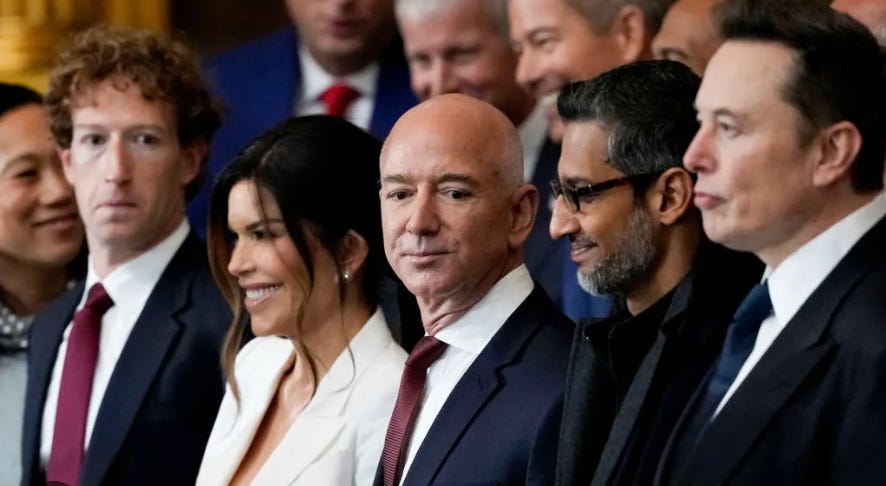
Ironically, China’s booming technology sector is already a partnership between its government and technology companies. In April, OpenAI began pushing for a wealth fund that would provide citizens with a stake in AI-driven economic growth. Now Bernie wants to expedite the process, gain public ownership, and address the issue of inordinate economic power accumulating in the hands of a few tech billionaires. He wrote: “AI is built on humanity’s collective knowledge and the wealth it generates must benefit humanity – not just Elon Musk, Sam Altman and other AI oligarchs.”
You quote Bernie Sanders as saying, “AI is built on humanity’s collective knowledge and the wealth it generates must benefit humanity – not just Elon Musk, Sam Altman and other AI oligarchs.” Except that his proposal is that only Americans should benefit. The rest of humanity should be left out in the cold, despite their indisputable contributions to “humanity’s collective knowledge. Those of us who are not Americans are supposed to agree with this?
The promise of something in exchange for nothing will always have its appeal.