The Space Age Cometh
May 25, 2026

(This is the first of three newsletters about the impending Space Age, which will transform human existence, energy, economics, and geopolitics.)
In recent days, everyone has read about Elon Musk’s “Monster Merger” of tech companies. It’s all dizzying to stock pickers and insiders, but this is not a business story. This is about the transformation of human existence and the beginning of the next phase of history: the exploration and exploitation of space. At its center is Musk, the world’s richest man, who is restructuring his business empire into a single gigantic AI-and-space titan, headed by SpaceX, his artificial intelligence company xAI, and with Tesla as its flagship automation and robotics anchor. Attention is on the market maneuvers, but Musk’s philosophical mission is behind all of this, and important to understand. “My companies are doing AI, robotics, space, and tech at the same time with the overall goal to maximize the future of civilization and expand consciousness beyond Earth.”

Musk grew up reading science fiction books and developed an interest in space exploration and technology. He has created incredibly successful businesses, and now wants to explore space, not to find aliens, but to protect human civilization. He believes that life and consciousness — the foundation of existence, which enables learning, empathy, and deliberate action — are rare and might only exist with human beings. “If that’s true, we must do everything possible to ensure life is not extinguished,” he said. “I see it as a tiny candle of consciousness in a vast darkness that could easily go out. This is why it’s important to make life multi-planetary, so if there is a natural disaster or manmade disaster on Earth, consciousness continues. That’s the purpose of SpaceX.”
He has singlehandedly ushered in the Space Age because his engineers are on the verge of breakthroughs in rocketry that will allow more exploration and development. “We are hoping this year to achieve full re-usability of our aircraft. Starship is the largest flying machine ever made (29 storeys tall), and in 2026, we want to prove full re-usability, which will be profound and will drop the cost of access to space by a factor of 100. The cost of access to space will be below the cost of freight on aircraft, under $100 a pound.”
The new economics of launching will allow SpaceX to undertake its major project, which is to build and launch enormous orbital data centres for AI computing by 2028. These will use solar energy to harness vast amounts of AI processing/computing capacity for use on Earth. He said, “Solar in space is five times more effective than solar on the ground. It’s always sunny, and there is no daylight, weather, or seasonal cyclicality. There is five times more energy in space than on the ground. The lowest cost place to put AI is in space, within three years.” (However, he must get permission from Washington so that his data centers do not disrupt existing telecom and research satellites that are already in orbit.)
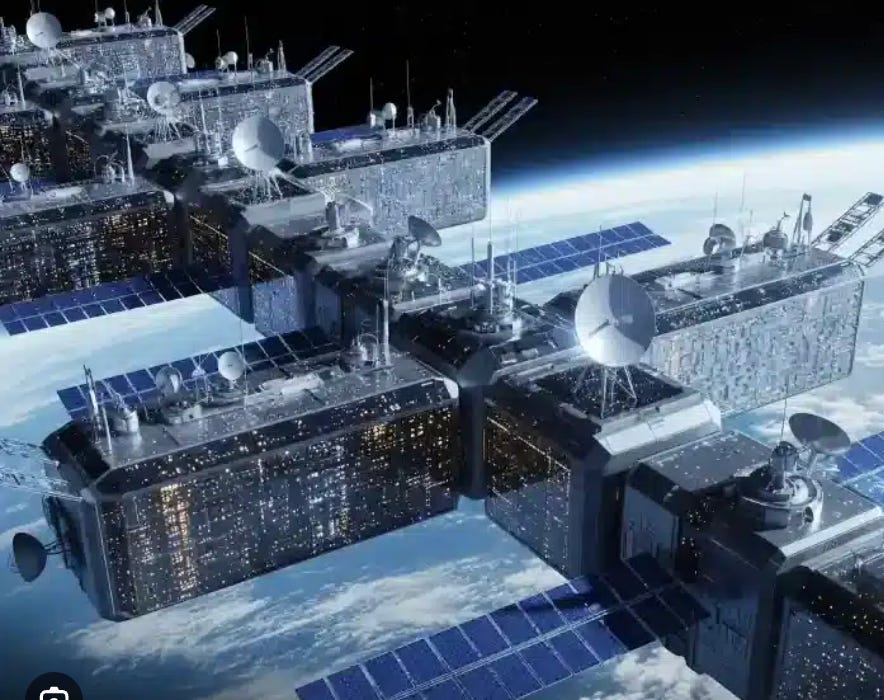
Data will travel from these orbiting AI data centers to Earth using high-bandwidth optical laser communications or high-frequency Radio Frequency (RF) links. Beams of light or radio waves will transmit information from the data center satellites directly to Earth-bound "optical ground stations" or teleports, which will then route the data via fiber optic networks to terrestrial AI training clusters.
This will address the problem of building enough electricity generation to meet the needs of technology on Earth. This will, in turn, provide enough AI compute to solve some of the world’s biggest problems, such as poverty, believes Musk. “People talk about solving global poverty, but the only way to do this is with AI and robotics. It doesn’t mean this would be without issues. We need to be very careful with both, and don’t want to find ourselves in a James Cameron ‘Terminator’ movie.”
“Electricity is an issue, and today there’s only 4% growth in maximum power,” he said in a recent interview. “By the end of this year, the U.S. will produce more silicon chips than we can turn on because of insufficient electrical capacity. The exception is China, and the U.S. is behind. But 99.8% of all the energy in the solar system comes from the sun. It’s all about the sun. In a few years, we will be launching solar-powered data centers. Space is a source of immense solar power potential, and there’s no need to take up any room on Earth. The scale is enormous.”
Ubiquitous and free AI computing will, in turn, lead to expansion of the global economy “beyond all precedent”, he said. Tesla is a leader in robotics. “There will be a large number of humanoid robots, which will increase productivity. My prediction is that robots and AI will meet all human needs, and there will be an abundance of goods and services, and more robots than people. If you have billions of humanoid robots, everyone will have one to watch their kids, walk their pets, and take care of elderly parents. I’m optimistic about the future, and it will be the most interesting time in history,” he said.
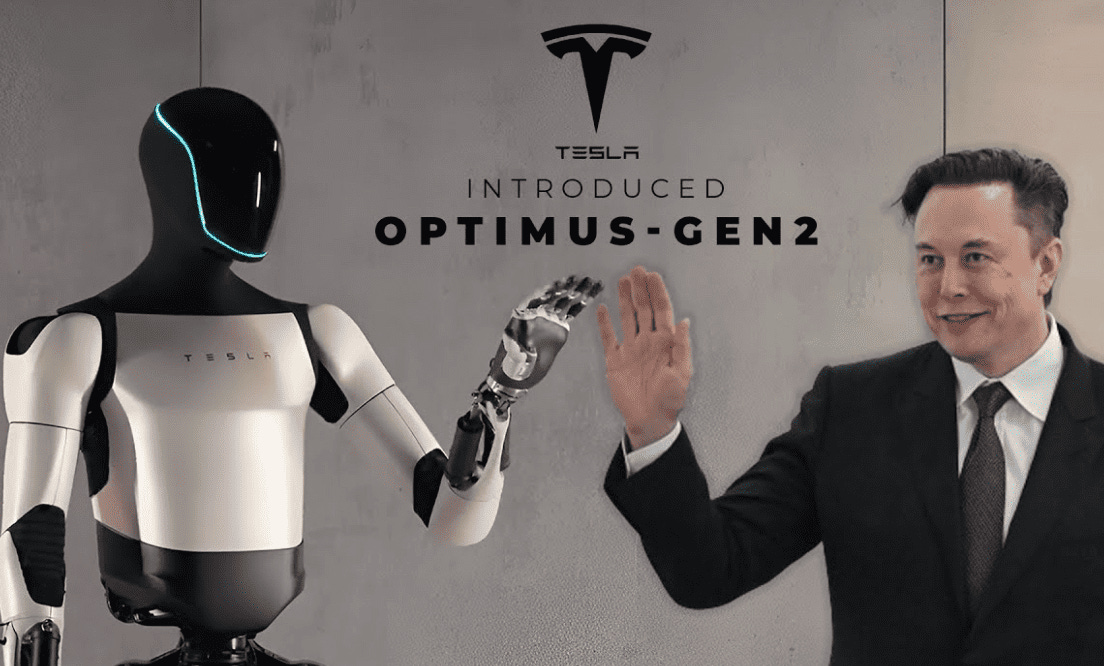
Musk said his “humanoid robotics” will advance quickly. “Some now do simple tasks, but by the end of 2026, they will be doing more complex tasks in industrial environments. In 2027, we will be selling humanoid robots to the public. Self-driving cars are a solved problem, and robo-taxis are being rolled out in Europe and China this year. In 10 years, we might have AI that is smarter than any human, and by 2030 or 2031, AI will be smarter than all of humanity collectively.”
Frankly, it’s a terrifying prediction unless AI and robots remain under the control of human beings. To allay such concerns, Musk advocates for regulatory oversight and AI safety, as have other Silicon Valley tycoons. There will be watchdogs, but at the same time, Washington intends for America to remain the world’s AI-dominant player. Without guardrails, Musk’s future looks more like “Mad Max” than “Star Trek”, but he says the transition is essential and cautions against letting fears take hold. “The future of humanity is going to bifurcate in two directions: Either it’s going to become multiplanetary, or it’s going to remain confined to one planet, and eventually there’s going to be an extinction event,” he said.
He believes that a great future lies ahead but will require hard work, risk, and deliberate engineering, he said. “I think if you want the future to be good, you must make it so. Take action to make it good, and it will be.”
(Next: “Japan Leads Space Race” on May 28 and “Space and Geopolitics on June 1)
If Musk wants to ensure that humanity survives why doesn't he start with using some of his wealth to help bring about the end of the war in Ukraine. Now the Russians no longer have access to Starlink, but he could do so much more. Recognise Russia as the aggressor and promote this within the US administration where he has an intro. He talks about ending poverty. It is quite possible and well within the earths current economic capacity to already bring about the end of poverty. Poverty continues on earth because it suits the playbook of various dictators and their regimes. Keep the people down and hungry.
In Das Kapital, Marx never mentions communism; only a "Workers Paradise" where automation was doing all the work and people were free to do as they wish.
Is it finally coming to pass? Will everyone not want to work?
That is doubtful. Just as there are lap dogs that are fat, dumb and happy when not yapping at a perceived threat, there are work dogs that will suffer if not doing whats in their blood, e.g. hunt, herd, attack.
So what percent of the population will continue "making" (as meant by the German "macher")? What percent will basically eat, sleep, and party? Will it be a two class society? Or perhaps three since a celebrity class will be needed to give the majority of people something to text/post about.
The "machers" will probably be a minority...perhaps 15% to 20%.
Will they need to have their right to work protected?
What if their chosen activity is of the aggressive sort? One can imagine that prisons will be a constant.
Will education be a constant? Will people still want to learn if "all" the learning has been done?
Ancient Rome had "robots" too and most citizens were without want. There was plenty of bread and circuses. How did that end up?